I Finally Finished My Cyberdeck
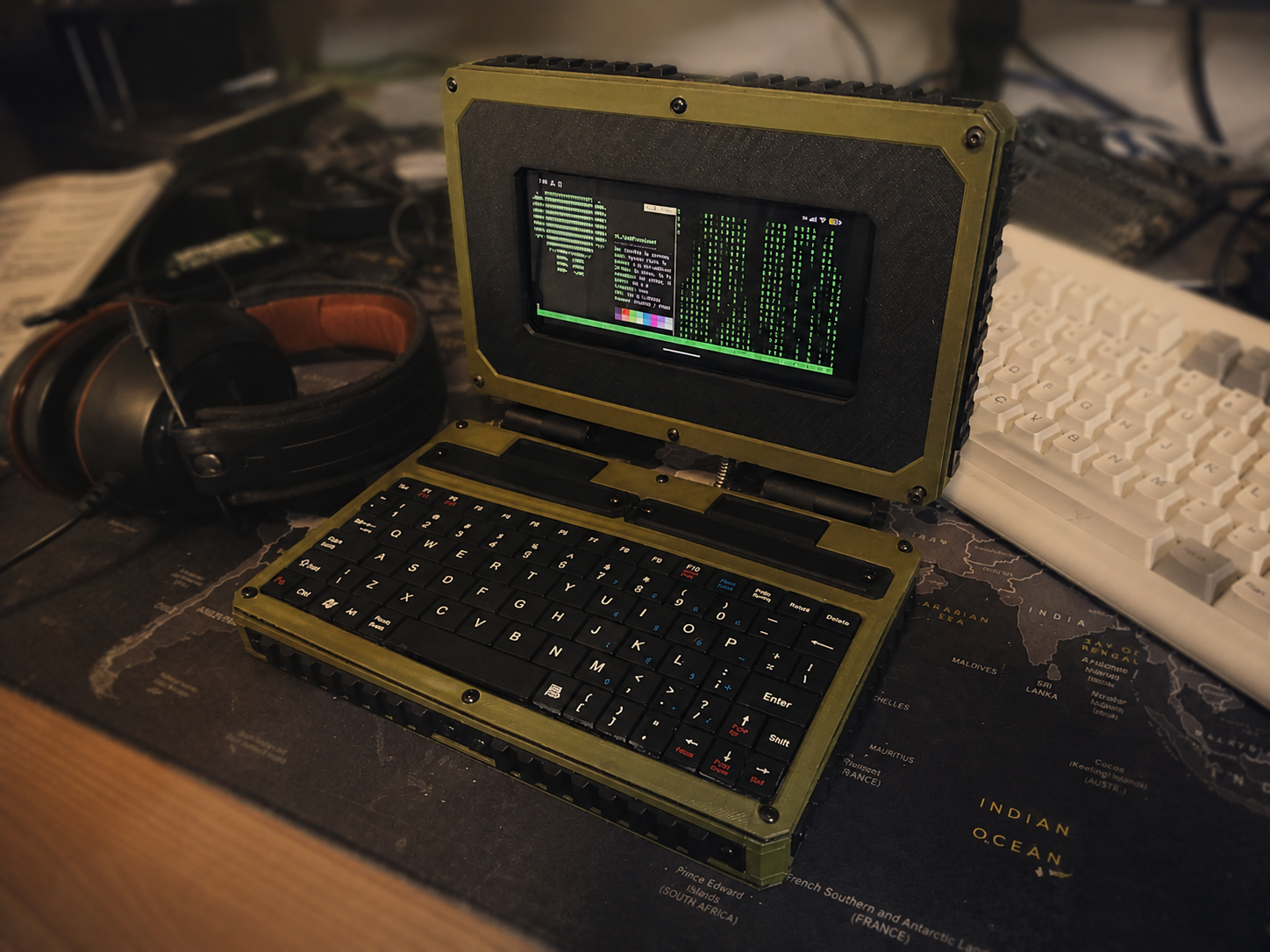
It’s done!
I’ve been chipping away at this thing for way longer than I’d like to admit, and after more failed prints, redesigns, and “why is this almost right but not quite” moments than I care to count, it’s finally sitting on my desk exactly how I pictured it. That doesn’t happen often.
What I was going for
From the start, I wanted it to feel rugged. Not “fake rugged with some texture slapped on,” but actually built like it belongs in a Pelican case somewhere.
Olive drab, exposed fasteners, chunky edges, foam around the screen. I kept thinking “90s military sci-fi laptop” and just fully committed to that vibe.
The modularity rabbit hole
The main goal was flexibility. The deck is designed to fit a standard 7” Raspberry Pi display, but it’s not tied to one setup. I wanted it to handle different SBCs depending on what I’m doing.
There’s also a custom insert for my Pixel 7a, so I can drop the phone in and basically turn the whole thing into a portable terminal with a keyboard via Termux. So it’s somewhere between a mini laptop or i can detach it from the base an use it as a tablet.
Sounds simple on paper. It wasn’t.
Once you start designing for multiple configurations, everything starts affecting everything else. Mounting points, clearances, tolerances… it turns into a constant balancing act in Fusion 360 where changing one thing quietly breaks three others.
The painful part (hinges, obviously)
The hardest part by far was the hinges.
I made a rule early on: no supports. Partly for surface finish, partly because removing supports on small mechanical parts can wreck tolerances. That sounds reasonable until you realize it forces every overhang and internal feature into a very tight design space.
So the hinge got redesigned. Then redesigned again. Then again.
There were failed prints, almost-fits, and a few moments of “I should probably just buy a laptop and move on.” But that’s kind of the deal with these projects.
I also planned for heat-set inserts throughout the design to give it a more finished, serviceable feel. That was partly about durability, but also just making it feel less like a prototype and more like something you could actually take apart and put back together without stripping plastic every time.
That said, they’re not strictly required. If you want a simpler build, you can absolutely run it with self-tapping screws or friction fit depending on the part. The inserts just take it from “functional print” to something closer to real hardware.
Where it ended up
It works.
It can run as a standalone tablet-style setup or open like a mini laptop. Most of the time it just sits on my desk acting as a fancy paperweight… but it’s cool to have built something from scratch, straight from my own imagination and design. It’s completely functional, just not exactly “useful” in the traditional sense—haha.
But mostly, honestly, it just looks right. Like something slightly overbuilt that absolutely should not be asking polite questions of your network.
Mission accomplished.
STLs are going up on GitHub / Thingiverse soon